
01Beginnings
A difference almost too small to see
The universe today contains galaxy clusters and immense regions with very few galaxies. The early universe was much smoother. There was no dust yet and not a single star, but the matter was not spread perfectly evenly. Some regions were just a little denser than their surroundings.
As the universe expanded, gravity kept working. A slightly denser patch attracted more matter. With more matter, it pulled a little harder. Given enough time, those modest differences grew into the structures we see today.
02Gravity
Gravity weaves a web
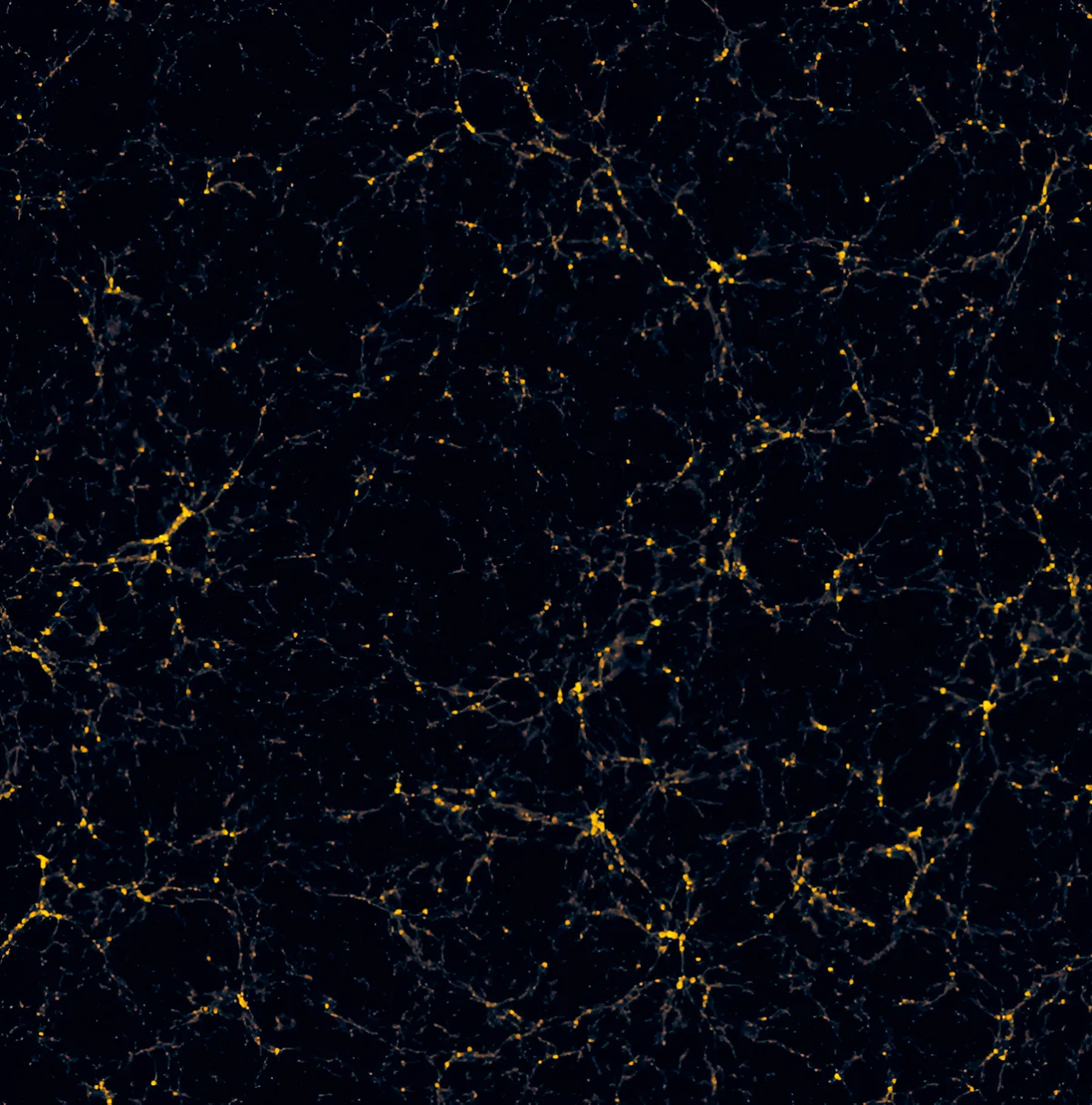
Matter does not gather at the same rate in every direction. Some regions collapse first along one axis into sheets, and then along another into slender filaments. Where filaments meet, matter accumulates into knots that can become galaxy clusters. Between them lie the voids.
Dark matter makes up much of this framework. Ordinary gas falls into the gravitational wells it creates. Some of that gas cools and forms stars and galaxies. The light in our telescopes picks out only part of the underlying web.
03Stardust
The dust came later
Gravity brought gas together before stars could transform it. The earliest stars were made mostly of hydrogen and helium. Later, nuclear reactions inside stars made elements such as carbon and oxygen. Winds and explosions returned some of those elements to space, where they became ingredients for interstellar dust and planets.
The carbon in us once formed inside stars. It sounds like poetry, but it is also a history we can trace through the elements. The web was not destined to produce us; it gave stars, planets and, eventually, life somewhere to happen.
04Kinship
Connected, not alike
Genesis opens with darkness over the deep and the spirit of God moving over the waters. It is an ancient way of imagining a beginning, not a record of the early universe. A Buddhist teaching offers another simple reminder: things arise because many conditions come together. Neither answers the same questions as cosmology, but both leave room for a question of their own: can we understand anything entirely apart from what surrounds it?
There are no cosmological filaments between people. But a word, a letter, or a hand extended at the right moment can change the route of another life. Years later, nobody may remember how brief the moment was, even as the change continues.
Across the empty spaces, we can still bring one another light.